"I WANT TO BE A PART OF IT..."
- katharinetonti
- Jul 29, 2025
- 4 min read
Updated: Apr 18
A week in New York. A lifetime in theatre.
Originally posted 04.14.2020. Revised and edited 07.19.2025
I went to graduate school to become a theatre director.
I still remember standing in the office of the Chair of the Theatre Department, boldly declaring my intent. His response? “There are no women directors. Women do not direct.”
That was September 1974.
Looking back, I probably should’ve packed my bags and looked for a different program—one that welcomed the idea of women directing. But I didn’t. I stayed. I also graduated.
Then I went to New York.
A friend from grad school invited me to stay with her and her roommates until I could find a place of my own. They were gracious hosts, but the three of them were crammed together in a 480-square-foot studio apartment on West 23rd Street. It was clear they couldn’t squeeze in one more person for more than a day, so my friend helped me land a spot at the Barbizon Hotel for Women on East 63rd Street.
New York City has changed dramatically since the 1970s and ’80s. Back then, it was the murder capital of the country. Sirens wailed through the streets 24/7. The theatre district—bordering the aptly named Hell’s Kitchen neighborhood—was chaotic and grim. Trash, drug needles, broken glass, porn shops, prostitutes, addicts, and the unhoused were just part of the scenery.
The streets looked like a deranged set designer’s version of The Inferno. There was a real threat that you might get mugged, robbed, or murdered (possibly all three) depending on the area of town you had the courage to walk through.
For a week, I spent my days trying to land a job—something that didn’t require changing my name to “Amber” or “Cinnamon”—and my nights in the theatre. I didn’t have any luck with employment, but theatre? I hit the jackpot. I saw the original cast of Chicago with Gwen Verdon, Chita Rivera, and Jerry Orbach, along with two Off-Broadway shows I’d eventually direct or perform in myself: The Club and Vanities.
I lasted one week. I just wasn’t ready. Raised in a sheltered environment, I was unprepared for the reality of that city—and the idea that I had left home for grad school had already pushed the limits of what my family could comprehend. Immigrating to the United States seemed less radical by comparison.
What surprises me now is that I never even considered going back. Not at a different time. Not once I’d grown stronger or braver. I simply closed the door and accepted the fact that I’d never direct in New York. I also never thought to try somewhere else—Chicago, LA, Austin, or even Miami. It was New York or nowhere.
So, I came home. Found a job. Built a life. Integrated myself into the local theatre community. Worked by day, acted and directed by night. Some experiences were magical. Others were, shall we say...educational. I even started a theatre company—we mounted about half a dozen productions, as I recall.
That’s when I learned: I don’t want to run a company. I don’t want to chase down grants, worry about ticket sales, clean toilets, or walk around a dark stage muttering, “Why can’t anyone put the hammer back in the damn toolbox?”
I wanted to do one thing: Direct.
This isn’t a sour grapes story. Quite the opposite. Because I’ve always had a full-time job, I’ve had the privilege of saying yes to directing shows I truly love. I don’t have to direct to pay the bills. I once took on a show I didn’t like, and it showed. I swore I’d never do that again.
Instead, I focus on stories that move me—and on working with actors I enjoy. When you find the right script, the right space, and the right cast? There’s nothing better.
In the 40+ years since that conversation in the department chair’s office, a lot has changed. Women direct everywhere now—from Broadway to black box spaces, from London’s West End to repurposed storefronts and church basements. Some of them win Tonys, too.
Julie Taymor was the first woman to win the Tony Award® for Best Director of a Musical, for The Lion King. It’s still running, by the way. She and I are the same age. (I’m fairly certain she went to a different grad school, though.)
I’ve returned to New York many times over the years, mostly to see shows. When I saw The Lion King, the Tony Award was displayed in the lobby. I remember turning to my friend and saying, “Let me just stand here a minute. This is the closest I’ll ever get to one.”
New York City is different now. So am I.
But you know what? To this day, I know my best work is waiting for me— right here at home.
I Want to Be a Part of It” is taken from the song “New York, New York,” composed by John Kander with lyrics by Fred Ebb. Originally written for the 1977 Martin Scorsese film New York, New York.
Chicago — book by Fred Ebb and Bob Fosse, music by John Kander, lyrics by Fred Ebb. The musical is based on the play by Maurine Dallas Watkins and was originally directed and choreographed by Bob Fosse.
The Club: A Musical Diversion by Eve Merriam. Directed by Tommy Tune, with musical direction and arrangements by Alexandra Ivanoff. Premiered in 1976.
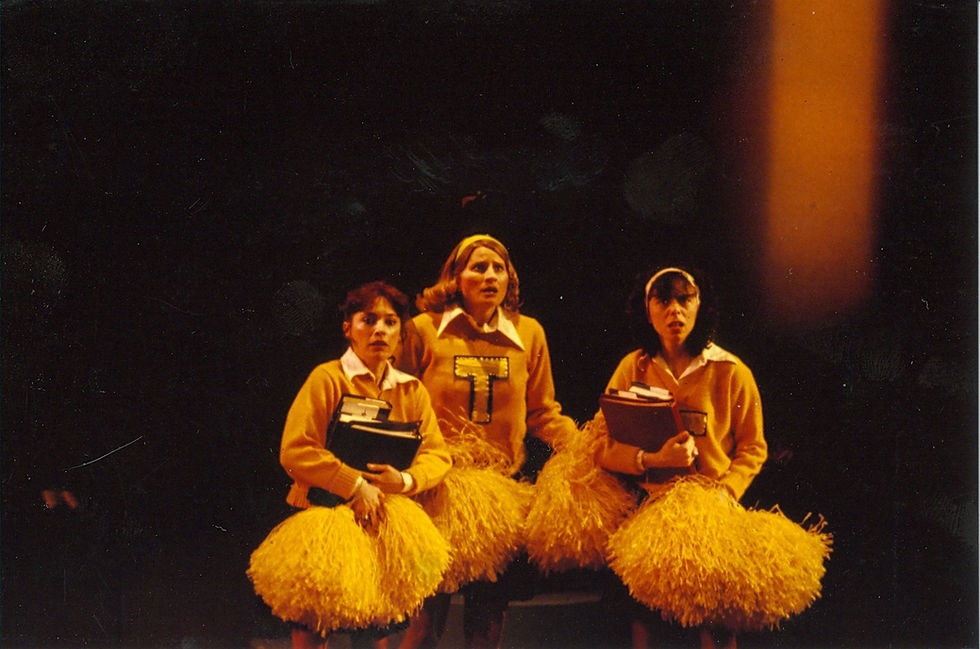
Vanities: A Comedy in Three Scenes by Jack Heifner. Originally presented by Playwrights Horizons in conjunction with the Lion Theatre Company in 1976.
The Lion King is produced by Disney Theatrical Productions. Originally produced for Disney Theatrical by Peter Schneider and Thomas Schumacher, with Donald B. Frantz as associate producer. Book by Roger Allers and Irene Mecchi. Music by Elton John, lyrics by Tim Rice. Directed by Julie Taymor and choreographed by Garth Fagan.

Comments