“THE ROOM WHERE IT HAPPENS”
- katharinetonti
- Aug 27, 2025
- 4 min read
Updated: Sep 5, 2025
08.23.2025
Some people skydive for the adrenaline rush. I direct community theatre.
Next year, I’m scheduled to direct a production at a local community theatre. The prospect is both exhilarating and terrifying.
Those feelings pulse through me every time I direct a show. First, because directing is my true love – nothing comes close – except maybe watching videos of golden retriever puppies zooming thru a yoga class. Second, because it’s an awesome responsibility. I use “awesome” here in the original sense: overwhelming, amazing, astounding.
Directing is one of those things that’s hard to explain to people outside of theatre, so I thought I would, periodically, share some thoughts as I start to prepare. To be clear, this is how I work. Every director is different.
So, generally speaking, what is it that directors do?
We don’t raise money, memorize lines, design sets or costumes, choreograph dances, or sell tickets, although in some community theatre settings, sometimes you do a little of everything. But that’s a story for another day.
For me, directing starts about six months before auditions. It’s the period of time when I do script work and research. I read and re-read the play dozens of times, so that I understand both the story and the authors’ intent.
I start by asking myself this question: What story is the playwright trying to tell?
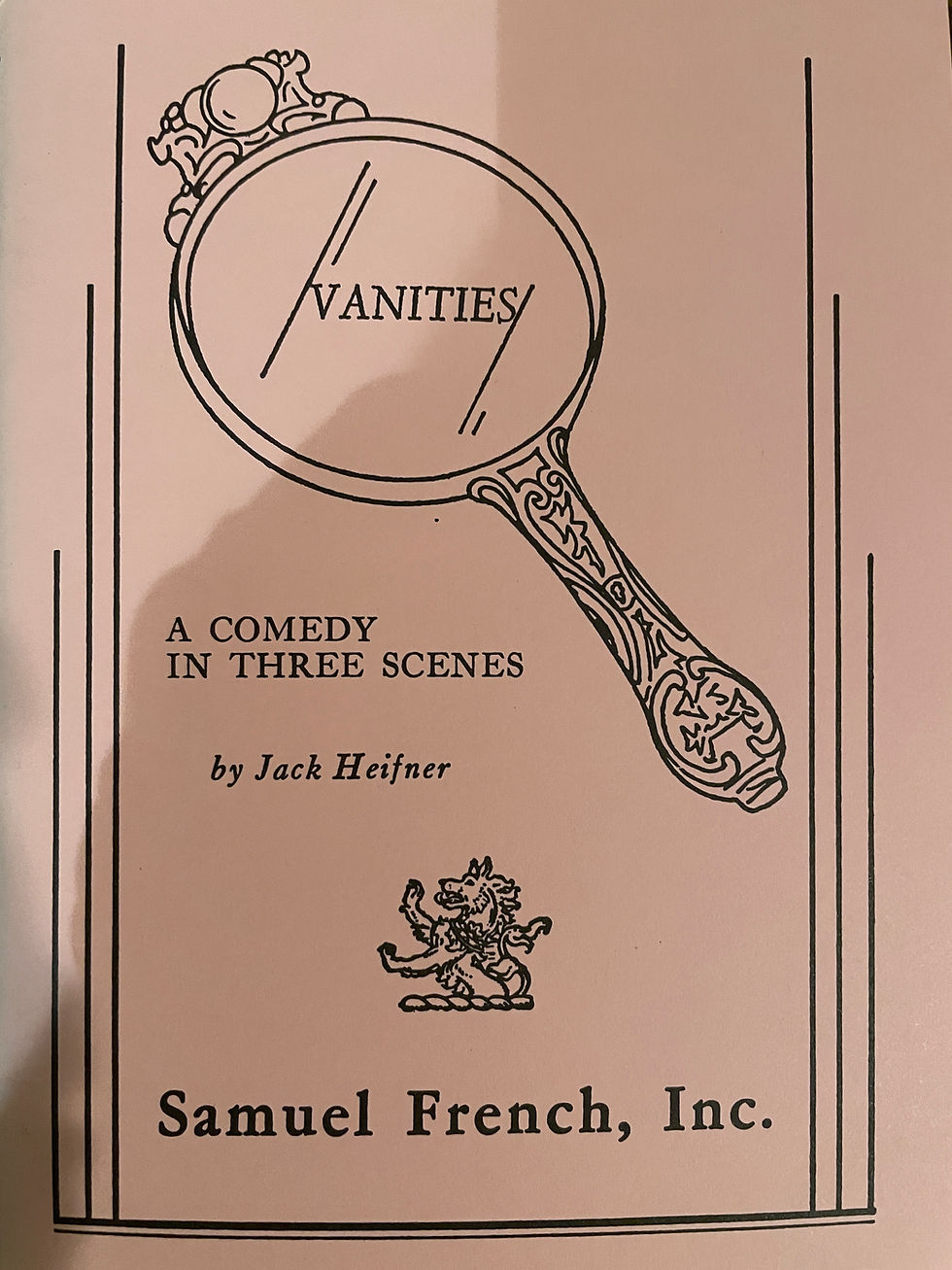
In the case of the show I’ll be directing, Vanities, by Jack Heifner, it’s a story about three women who are best friends in high school. It follows their journey in college, and then about five years after they graduate. On the surface it’s a play about friendship and how those friendships evolve over time.
But from a directing standpoint, there’s the opportunity to bring my point of view to the script. I can nuance it so that it’s a story about growing up and accepting that everything changes, including friendships. Or I can nuance it so that it's a memory play about the loss of innocence and youth. In either case, it’s the same script – but it will be a different play.
When I talk about a point of view, the best example I can give is Romeo and Juliet. That play can be a story of young love, or a story about two reckless teenagers who cause the death of six people. Either way, it’s the same script….but is it the same story?
For script work, I begin by typing a copy of the script. While this seems unnecessary – one can always copy the script and put in in a director’s book and work from there - I find typing out each word that will be spoken on stage critical. I can “feel” the playwright at work and see his/her/their preferences. Do their characters speak in long sentences or short ones? What type of words do they like to use? How often do they repeat the same words – why?
For example, in the first scene of Vanities, the three characters often begin their lines with one of three words: “Okay”, (12 times) “Ohh,” (10 times) and “Well,” (19 times).
Why does this matter?
Words like “Okay,” “Ohh,” and “Well,” slow things down. A person usually pauses after those words. If you’re trying to build a fast pace where the actors are talking like teenagers, the scene has to move fast – the lines should tumble over themselves. If the pace slows down - 41 times in the first scene alone - the show will drag, and the next thing you know, someone in the audience has either fallen asleep, or is scrolling through their cell.
Not that you, as a director, will change any of the lines – not your job - but it should go into your notes to discuss with the actors when you’re working on pace. (One of my favorite ways of describing it is this: We need higher highs, lower lows, a faster pace, and slower sentences.)
Doing historical research: The first scene in this play takes place in a gymnasium in Dallas, Texas on November 22, 1963. I was in grade school that day, and still remember it well, but the actors I’ll cast won’t be born for at least another 40 years.
Sure, they can Google the events of that day, but it’s imperative that I rely not on my emotional memory of what happened, but on the events themselves as recorded in history. As for audience members, some of them may also be transported instantaneously to where they were on that fateful day, but my job is to keep them in that gym with those girls.
Then there are other, simple things that make a difference in terms of authenticity. If it’s 1963, the sound of the bell that announces the beginning of one class/end of another, cannot be digital – it has to be the old-fashion ringing bell - the kind that clanged so loud and so hard, it could loosen a tooth filling.
When it comes to historical research, this is the tip of the proverbial iceberg. It’s absolutely imperative that that you, as a director, do your homework. (Much more on this type of research in a future essay.)
Now, full disclosure.
Decades ago, I was in a production of Vanities, and a few years later, I directed a production, so why would I direct it again?
Like everything else in life, you see things differently as you get older/wiser, and now, I see each of these characters differently, as well. I’m much more sympathetic to the character who is heartbroken that things have changed dramatically, and far less so about the character who has reinvented herself in an attempt to distance herself from – well, herself.
As I mentioned, there will, periodically, be future essays on topics like designing the playing space, prepping for auditions, blocking the show, rehearsals and working with actors on characterization and interpretation. But for now, I wanted to provide you with the briefest overview of the pre-work I do, and share with you why I love directing so much.
In the end, if I do my job right, the audience won’t notice me at all. I’ll just be the person at the door, welcoming people in, guiding them to their seats, pointing out where the bathroom is located, and reminding everyone to ”please, turn off your electronic devices before the show begins.”
All I can say is, being invisible has never felt so good.
The Room Where It Happens,” written by Lin-Manuel Miranda, from the musical Hamilton (2015).


Precisely Summer 1978 I was invited by a local director to try out for Vanities. She had seen me in a few productions and thought I would be ideal. The advanced state of pregnancy (child born December 28, 1978) made this an unrealistic choice.