"EXIT, PURSUED BY A BEAR"*
- katharinetonti
- Oct 15, 2025
- 6 min read
Updated: Apr 19
10.15.2025
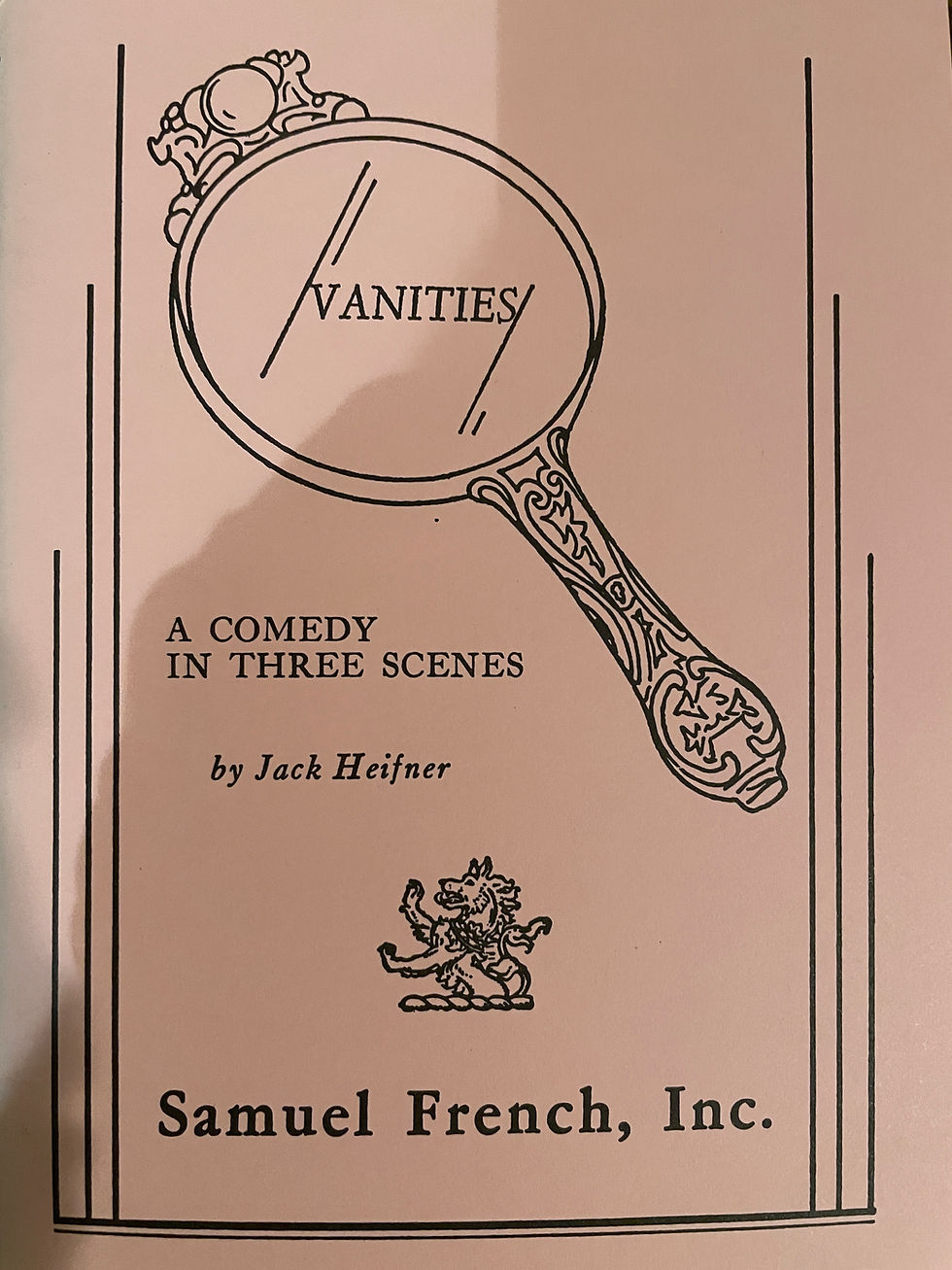
A few weeks ago, I shared with you that I’ll be directing a production of Vanities by Jack Hiefner, in late spring of 2026. In that essay, I talked about the script itself and the work I do around understanding both the story and the language the playwright uses.
The next step – and the one I’m currently working on – is blocking the show. For those not familiar with blocking, the simplest way to describe it is that it’s the movement that occurs on stage by actors, excluding choreography and stage combat. So, if an actor moves from one side of the stage to the other, that is one piece of blocking. When you multiply the number of characters in a show, times the number of times each one enters, exits, walks towards, walks away from, crosses to sit, crosses to stand, etc., a show can have hundreds, if not thousands of pieces of blocking – and the director’s job is to map each one of those movements.
In many theatres, the director doesn’t start blocking their show until they discuss the production with the set designer, who then provides the director with either a model of the set, or drawings of the floor plan. There’s no sense starting to create blocking if you don’t know what the physical environment looks like, or where the furniture is going to be placed, or if a door is going to be center-stage, or down stage right.
In some cases, black box theatres don’t have the luxury of hiring set designers, so it’s up to the director to design their own set – which is the case with the show I’m doing.
The space I’m working in can be configured in multiple ways – proscenium, in the round, three quarters, etc., so the first question I have to answer is “where is the stage and where is the audience?”
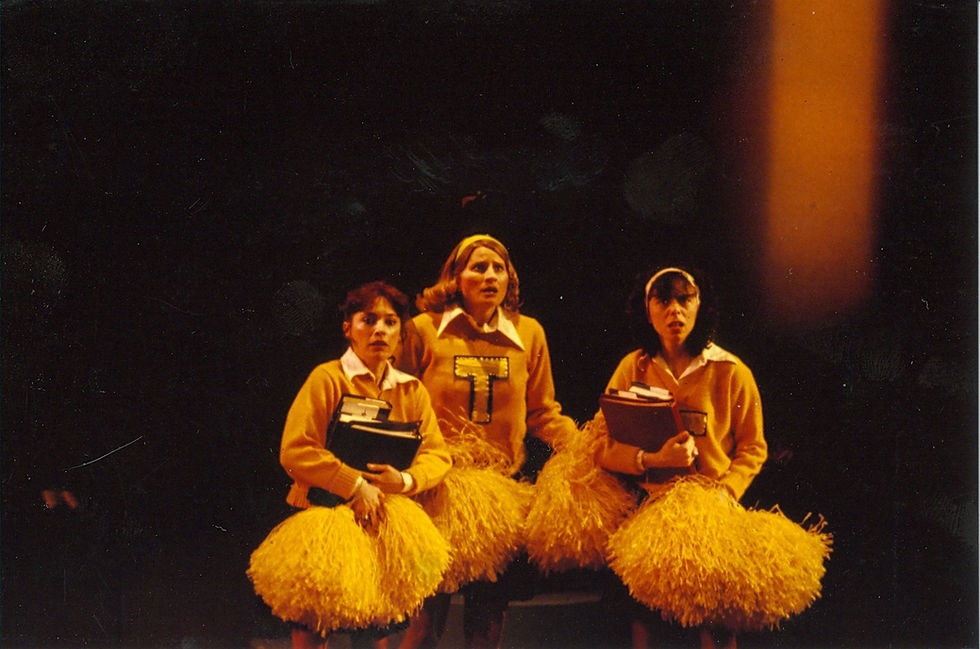
I’ve chosen to play the show in a proscenium setting, primarily because the script requires the actors to be visible during scene changes. Also, if you recall, in the first scene the three women are high school cheerleaders, and from a practical standpoint, it’s easier to stage the cheers when all three women are facing in the same direction.
When blocking is done well, it should help tell the story. It should create interesting stage pictures – no one wants to see a group of actors standing in a straight row unless it’s a production of Chorus Line. Having some actors stand while others sit, makes it visually more interesting for the audience to watch. But if actors stay in one place too long, the show becomes static. That’s why you’ll often see a character stand up and cross away…(for example, they'll cross to a bar cart to pour a drink) in order to create distance between themselves and another character.
The biggest challenge with blocking is that it should underscore the scripts’ inherent dramatic tension. Tension in a scene has been described as pulling on a rubber band and releasing it over and over again. In the book, NOTES ON DIRECTING by Frank Hauser and Russell Reich, the authors talk about every scene being a chase scene. One character has something the other character wants. What is it, and what will the first character do to get it? And what is happening on stage to physically demonstrate the chase?
In some plays, it's obvious. In murder mysteries, for example, the Inspector wants to find out who the murderer might be. They may approach the suspect, pace around them, assume a higher position and “get in their face” while the suspect is sitting in a chair, etc. In other plays, like Vanities, it’s more subtle, and more of an internal struggle. For example, one character doesn’t want the world around her to change, but when she realizes she can’t hold on to the past, the results are catastrophic.
In Vanities, we see the three characters at three different intervals – 1963, 1968, and 1973. In 1963, they’re bubbly teenagers, so it makes sense to keep the three of them close together as much as possible. While their fundamental differences start here, it shouldn’t be that noticeable. It’s critical not to give away the ending of the show before the drama has a chance to get started.
As the show progresses, there should be more space between each character – physical and psychological space, which is underscored by longer pauses between their lines. Literally, the show stretches out – and while this presents pacing issues – the few times the characters do come together toward the end of the show are intense.
One of the many challenges in developing blocking – and where a director’s point of view plays a critical role, are the choices made in those intense dramatic moments. If the scene has two characters arguing – are they doing it standing nose to nose, or yelling at each other from across the stage? Are they walking away as they’re yelling, or coming closer together? Is one standing still, and the other pacing? Is one trying to get away, while the other follows?
You can imagine the options available – all of which are underscored by the logistics of the set pieces – are they arguing in front of, behind, or around the furniture? Is one character at a physical disadvantage to the other, and if so, how do you compensate for that? At this point, you start to question, “Why did I want that chair over there, and if I move it now, will I have to reblock the whole scene?” More often than not, the answer is, yes, you need to move the chair and reblock the scene, and maybe rethink the chase all together. (Theatrically, few things are worse than when a piece of furniture suddenly takes on the leading role in your production.)
Now, some directors allow actors to “block” themselves, meaning the actors decide where they’re going to move based on what they know about their characters. I’m not a proponent of that because blocking takes place early in the rehearsal period and at that point, most actors don’t know their characters well enough to make those decisions.
Also, actors are not thinking about their fellow actors when they do that, so it’s not unusual for you then to see actors “counter crossing”, that is, moving in the opposite direction, so they can continue to be seen when actor A walks across the stage and then stops dead in front of them (also known as upstaging.)
I block out 95% of my shows, then allow actors to make adjustments. Sometimes their instincts are great, sometimes not. Occasionally, they bring up something I’ve not considered, and for that, I’m always grateful. Putting on a show these days is a far more collaborative effort than when I started out, and an actor’s insight is appreciated.
But in general, actors - and I say this with sincere love and respect, having been an actor and working with them now as a director – can be self-centered. Their focus is on their lines, their character, their blocking, their costumes, their props, etc. That’s not to say that when they’re comfortable with all those things, that they’re not generous. Most are, but they certainly can’t see the show from the same perspective as the director who is sitting in the audience. And ultimately, that’s our job – to produce a product for the audience’s benefit, not our own.
I’ve always said that there is nothing as useless as a director on opening night, and that is the truth. But up until that moment, the cast and the audience are counting on the director to create the environment and the structure - and have a clear, distinct vision for telling a story in a fresh and imaginative way. That’s job #1.
Next, I will be getting ready for auditions but that won’t happen until later this year, or the beginning of next. I know this is hard to believe, but often times, that process is more stressful for a director than for the actors because when the curtain goes up, every casting decision you made is staring right back at you from center stage. It can, quite literally, be a gut-wrenching process. To borrow a line from my favorite theatrical comedy series, Slings and Arrows, “If I were bothered by vomit, I wouldn’t work in the theatre.”
I also wouldn't have it any other way.
*Stage directions from William Shakespeare's A WINTER'S TALE, Act 3, Scene 3.

This was enlightening. I didn't realize so much work went into blocking.